
Why Banks Are Struggling to Support Customers as Financial Pressure Increases
As financial pressure continues to rise across the UK, so do customer expectations.
And increasingly, so do complaints.
For many customers, managing money is no longer just about budgeting — it is about survival in a landscape of rising costs, multiple subscriptions, and unpredictable outgoings.
But there is a growing disconnect.
Customers feel under pressure. Banks feel under scrutiny. And the gap between the two is widening.
The Customer Perspective
Customers today are dealing with:
- Rising living costs
- Increasing direct debits
- Multiple subscriptions and commitments
- Irregular cash flow
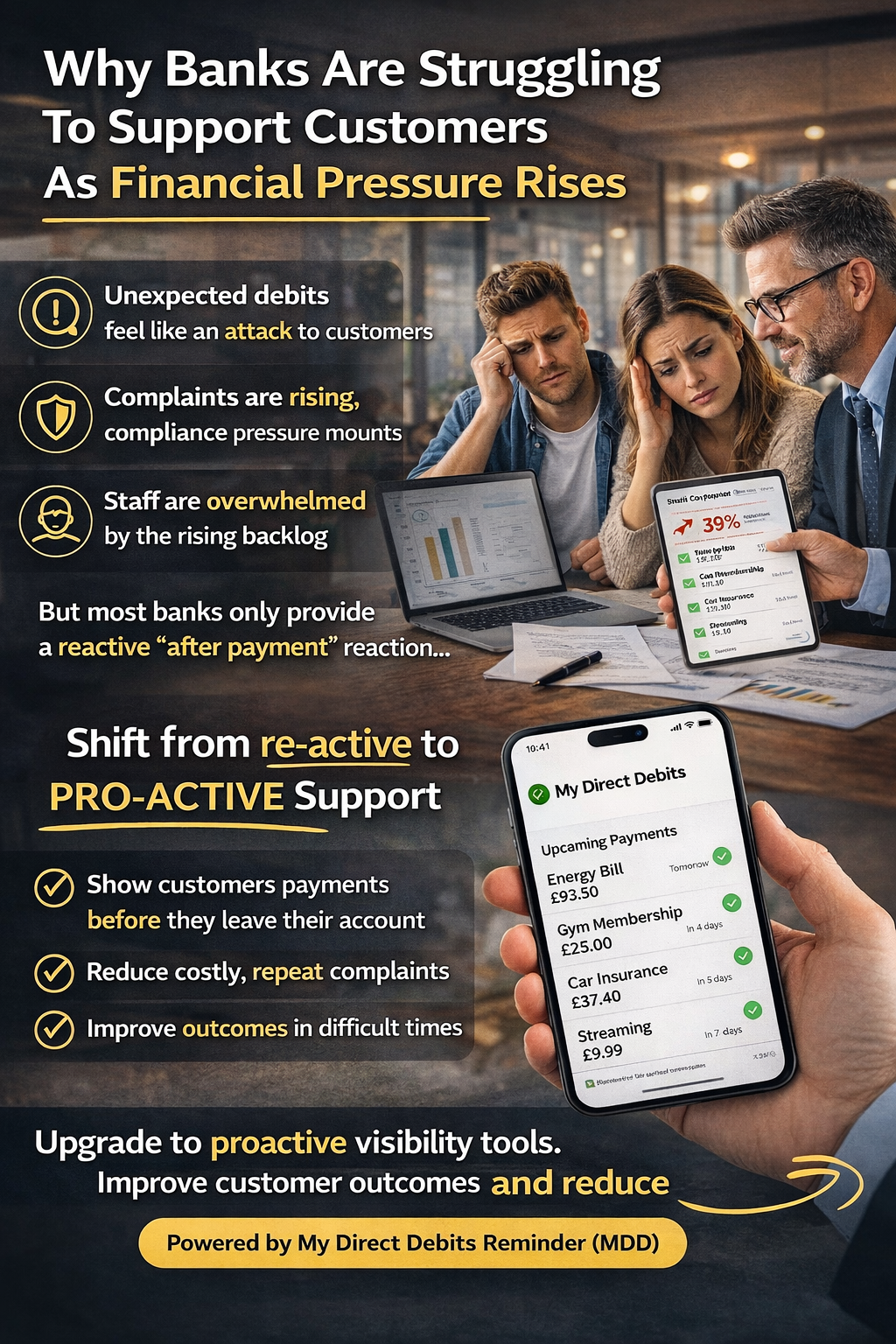
Yet when money leaves their account unexpectedly, the experience often feels the same: "Why didn't I know this was coming?"
To many, it does not feel like a system failure. It feels personal. It feels like losing control, being caught out, being constantly on the back foot.

The Bank's Challenge
Financial institutions are not unaware of this problem. In fact, they are under increasing pressure to:
- Reduce complaints
- Improve customer outcomes
- Meet FCA Consumer Duty expectations
But most banking infrastructure is still built around recording what has happened — not what is about to happen. And that is the critical gap.
Why the Current Approach Falls Short
Traditional banking systems:
- Show transaction history
- Send alerts after payments
- Provide fragmented visibility across accounts
But they rarely provide a clear, simple view of upcoming financial commitments. This means customers are reacting instead of preparing. Managing stress instead of preventing it.

The Result: A Breakdown in Experience
When customers feel repeatedly caught off guard, trust erodes. And when trust erodes:
- Complaints rise
- Support costs increase
- Customers begin to look elsewhere
Not because the bank failed them entirely... but because it did not support them early enough.
The Opportunity: Proactive Support, Not Reactive Service
The next evolution in customer experience is not more data. It is better timing of information.
Customers do not just need to know what happened. They need to know what is coming next.
A Practical, Ready-to-Implement Solution
My Direct Debits Reminder (MDD) was built around one simple principle: "Your bank tells you after. We tell you before."
It gives customers:
- Advance alerts (7, 5, and 1 day before payments)
- A clear view of upcoming outgoings
- The ability to plan, adjust, and act early
And importantly:
- No bank integration required
- No sensitive financial data stored
- No disruption to existing systems
Why This Matters Now
In a climate of financial pressure, small improvements in visibility create big improvements in experience. For banks and financial providers, this means:
- Fewer unexpected payment complaints
- Better alignment with Consumer Duty
- Increased customer trust and retention
Closing the Gap
This is not about replacing banking systems. It is about enhancing them.
By introducing a simple layer of pre-payment visibility, institutions can shift from reactive support to proactive customer care. And in doing so, close the gap between expectation and experience.

Interested in offering this to your customers or clients? Take our quick assessment to find out how proactive your organisation is: https://www.qualiquiz.app/quiz/is-your-organisation-proactive-or-reactive-in-payment-notifications
Frequently Asked Questions
Why are bank complaints increasing in the UK?
Rising financial pressure, combined with lack of visibility over outgoing payments, is a key driver of complaints.
What do customers expect from banks today?
More proactive support, clearer financial visibility, and fewer unexpected charges.
How can banks improve customer experience quickly?
By providing tools that give customers advance awareness of upcoming payments.
Interested in Collaboration or Partnership Opportunity?
Find out how proactive your organisation is with payment notifications
Take the AssessmentRelated Articles
Are Banks Financially Incentivised to Prevent Financial Difficulty—or Merely Manage It?
Should financial institutions continue perfecting the management of financial failure, or begin building the infrastructure to help customers prevent it?
Failed Payments, Small Fees And A Bigger Missed Opportunity For Banks
Banks can see payment stress before a Direct Debit fails, yet revenue is still built on penalties, not prevention. Here’s why that needs to change—and how.
How Small Payment Nudges Help Stop Debt Problems Escalating
Missed payments rarely start as a crisis. This article shows how small, well-timed payment reminders can quietly prevent debt problems from escalating.